

Siddhasana is a classical seated yoga posture used mainly for meditation, pranayama, and steady inner concentration meant to support spiritual practice and stillness.
Meaning
Siddha : ‘accomplished’ or ‘adept’ or ‘perfect’
Asana : ‘pose’ or ‘seat’.
How to Practice Siddhasana
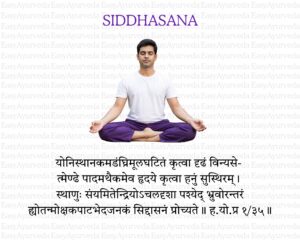
- Sit in a comfortable position on a folded blanket or a mat with the legs extended or in Dandasana .
- Sit with the heel of the left foot pressing the perineum, the area between the anus and the genital organ.
- Place the right foot so that the heel presses the pubis, directly above the generative organ.
- Slide the toes and edge of the upper foot between the thigh and calf as needed.
- Keep the spine long and upright.
- Relax the shoulders.
- Lower the chin slightly toward the chest if practicing the classical chin lock.
- Gaze gently at the eyebrow centre (Shambhavi mudra), or close the eyes.
A modern version often keeps the head upright with the eyes closed, which is easier for many practitioners and fits contemporary meditation practice.
Siddhasana is practiced as described above, with one heel pressing the perineum and the other at the pubic region. Swami Sivananda describes an alternate version where one heel presses near the anus and the other at the root of the generative organ, the heels resting one on top of the other.

Breath And Focus
In the classical form, the chin position creates a gentle Jalandhara-like effect, and the posture is traditionally linked with ujjayi and spontaneous breath steadiness. If the posture is used for meditation, the gaze can rest at the eyebrow centre or the eyes can remain softly closed.
Variation for Women
In traditional yoga texts, Siddhasana is often described as a posture for men. For women, a similar seated form is called Siddha Yoni Asana. The technique is mostly the same, but it is adapted to suit female anatomy and comfort.
Technique to Practice
Ø The method is almost the same as Siddhasana.
Ø Sit on the floor on a folded blanket or mat.
Ø The lower heel is pressed into the opening of the vagina
Ø The upper heel rests againt the clitoris
Ø The toes of both feet are inserted between the thigh and calf muscles.
Ø The posture is kept steady with the spine straight and the body relaxed.
Preparatory Poses For Siddhasana
Ø Sukhasana to make sitting more comfortable.
Ø Baddha Konasana to open the hips and groin.
Ø Janu Sirsasana to lengthen the spine and hamstrings.
Ø Ardha Padmasana for a simpler version of the pose.
After Pose for Siddhasana
Ø Dandasana (Staff pose)
Ø Paschimottanasana (Seated forward bend Pose)
Ø Shavasana (Corpse pose)
Benefits of Siddhasana
At the beginning of meditation, many postures may be suitable. But in deeper practice, when outer awareness begins to fade and inner awareness becomes stronger, Siddhasana is often considered especially useful.
Helps the spine stay upright for longer sitting.
- Encourages a steady body with less movement during meditation.
- Supports a calmer breathing pattern when combined with stillness and focused attention.
- Helps reduce restlessness during seated practice.
- It is traditionally linked with the rise of deeper meditative states and unmani (a mind beyond ordinary fluctuations).
- It is meant to support long meditation by helping the body remain quiet while the mind turns inward.
- The posture helps direct prana upward so that attention can settle at the eyebrow center, which is why it is often paired with Shambhavi drishti.
- Siddhasana is useful for self-control and celibacy. It is also considered a strong posture for those seeking deeper spiritual discipline.
Effects on the Energy Channels
- Balances Ida and Pingala and helps activate sushumna.
- Associated with stimulation of Mooladhara chakra.
- Classical texts describe it as a powerful seat for steadying prana and preparing for higher states of meditation.
- It stabilizes the two lower psychic centres, Mooladhara and Swadhistana chakra, redirecting the prana upwards towards the higher centres, this means that the posture helps control lower instincts, emotional restlessness, and scattered energy. The idea is that once these lower forces are balanced, prana can rise more smoothly toward the higher centers.
- It is often linked with awakening the Ajna chakra, the centre associated with inner awareness, focus, and deeper states of consciousness. When this centre becomes active in meditation, the practitioner is said to move beyond ordinary mental activity and closer to liberation.
Siddhasana in Classical Texts
Several Hatha Yoga classics describe Siddhasana as the most important asana.

Hatha Yoga Pradipika (15th century)
Ø “Just as moderate diet is the foremost of the yamas, and non‑violence of the niyamas, so all the siddhas declare Siddhasana as the best of the asanas.”
Ø It says Siddhasana purifies 72,000 nadis and is sufficient even if no other asana is practiced.
Ø When Siddhasana is perfected, the flow of prana stabilizes, kevala kumbhaka (spontaneous breath‑suspension) and unmani (mindless state) arise by themselves.
Gheranda Samhita
Gheranda Samhita (17th century) lists Siddhasana among essential meditative postures and emphasizes that when the yogi is firmly established in it, the three bandhas (moola, uddiyana, jalandhara) arise spontaneously.
Shiva Samhita and Hatha Ratnavali
Ø Shiva Samhita and Hatha Ratnavali also describe Siddhasana with one heel pressing the perineum and the other placed above it.
Ø Some texts note that placing one heel above the genital and the other on top is actually Guptasana.
Ø Sitting too long despite numbness or pain.
Anatomy Involved
- Arms: The elbows extended, and the forearms are supinated with the palms facing upward.
- Neck: The cervical spine stays in a neutral position, supported by the splenius capitis and splenius cervicis.
- Spine: The thoracic and lumbar spine stay upright, supported by the erector spinae, quadratus lumborum, multifidus, and transversus abdominis.
- Hip joints: The hips are flexed, abducted, and externally rotated, with muscle activity from the iliopsoas, adductors, abductors, and external rotators.
- Knees: The knees remain flexed and fixed in position.
- Ankles and feet: The ankles are in plantar flexion, and the feet are positioned in inversion or a tucked placement between the thigh and calf.
- Pelvis and perineum: The seated base rests on the ischial tuberosities, while pressure on the perineal region is an important feature of the pose.
- Core muscles: The transversus abdominis, multifidus, and pelvic floor muscles help stabilize the trunk and maintain spinal erectness.
- Lower limb muscles stretched: The adductor group, pectineus, quadriceps, gluteus maximus, and calf muscles are stretched depending on flexibility.
- Respiratory and cardiovascular response: Siddhasana has been shown to alter minute ventilation, tidal volume, oxygen uptake, carbon dioxide elimination, and heart rate.
- The studies suggest it may act as a mild form of exercise.
- It may be useful for people with low cardiorespiratory reserve, especially when heavy exercise is not suitable.
Precautions and Contraindications
- Siddhasana is not ideal for everyone.
- People with knee pain, hip pain, sciatica, recent surgery, arthritis flare-ups, or limited hip mobility should avoid forcing the posture.
- If the knees lift high or pain appears in the ankle, knee, or hip, use a simpler seated pose instead.
- Pregnant women and people recovering from an illness, should avoid Siddhasana.
Common Mistakes
Ø Forcing the knees or hips beyond comfort.
Ø Rounding the spine or collapsing the chest.
Ø Shrugging the shoulders or tightening the neck.
Ø Pressing the heel too hard into the perineum.
Ø Holding the breath instead of breathing smoothly.
Modifications
Ø Sit on a folded blanket to reduce strain on the knees.
Ø Use a wall for support if balance is difficult.
Ø Keep both heels lower and avoid forcing the feet into a deep lock.
Ø If full Siddhasana is uncomfortable, use Sukhasana or Ardha Padmasana as a stepping stone.
References
- Light on Yoga – Book by BKS Iyenger
- Hata Yoga Pradeepika – Swami Mukti Bhodhananda
- Anatomy of Hatha Yoga – H. David Coulter
- Gheranda Samhita.
- Rai L, Ram K, Kant U, Madan SK, Sharma SK. Energy expenditure and ventilatory responses during Siddhasana–a yogic seated posture. Indian J Physiol Pharmacol. 1994 Jan;38(1):29-33. PMID: 8132240.
- Critical Anatomical Review of Siddhasana. Journal of Ayurveda and Integrative Medical Sciences. DOI: 10.21760/jaims.10.9.25.


